The Alphabet of Audio: Understanding Amplifier Classes (A, B, AB, C, and D)
title: "The Alphabet of Audio: Understanding Amplifier Classes (A, B, AB, C, and D)"
description: "From audiophile purity to modern efficiency, decode what the letters behind audio amplifiers actually mean."
date: "2026-07-08"
tags: ["Audio", "Electronics", "Hardware"]
If you've ever shopped for audio equipment or dipped your toes into custom PCB design, you’ve likely encountered a bowl of alphabet soup: Class A, Class B, Class AB, Class C, and Class D.
But what do these letters actually mean? Do they stand for grades of quality? Not exactly. These classes describe the topology of the amplifier—specifically, how the transistors (or vacuum tubes) inside handle the incoming electrical audio signal.
Let's break down the alphabet of audio amplification, from the power-hungry purists to the modern marvels of efficiency.
Class A: The Audiophile's Heater
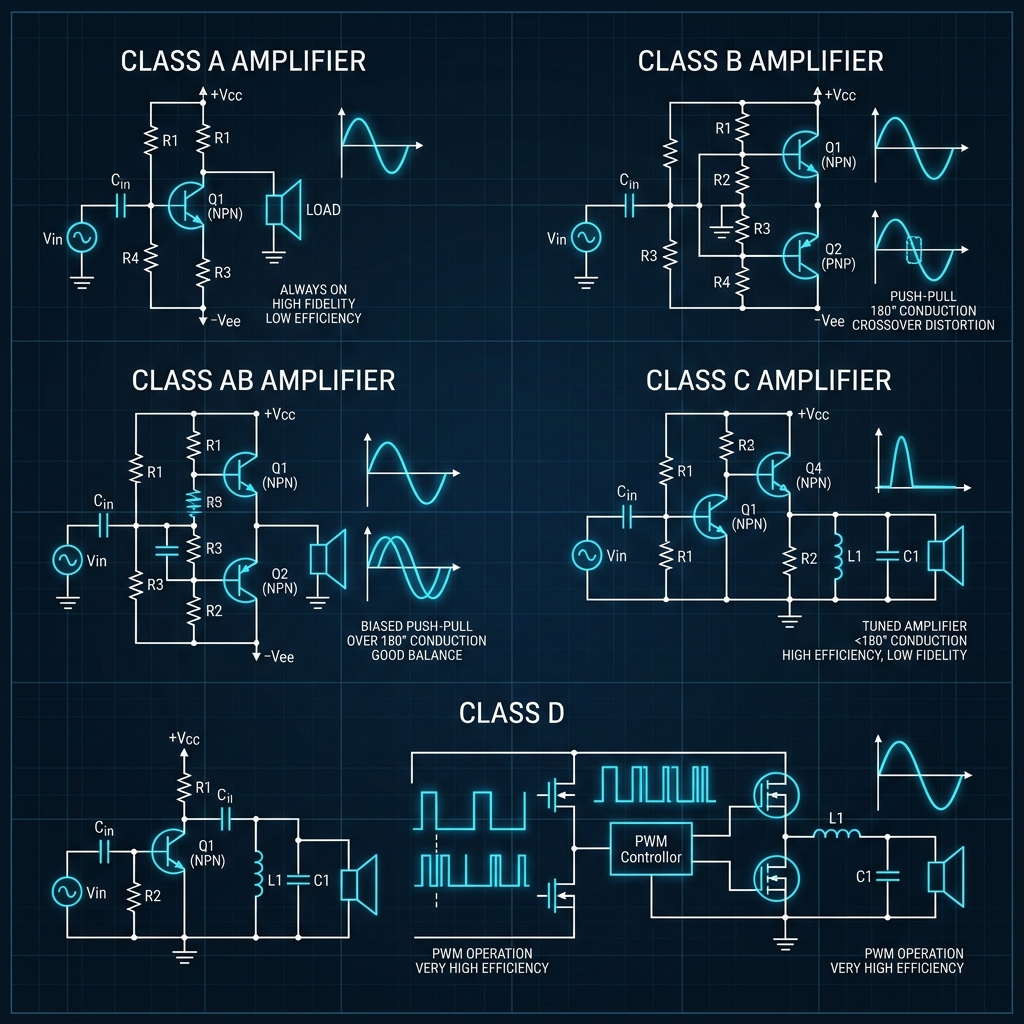
The Concept: In a Class A amplifier, the transistors are operating at 100% capacity, 100% of the time. The entire audio waveform (both the positive and negative halves) is amplified by the exact same continuous circuit.* The Good: Zero crossover distortion. Because the transistors never switch off, the audio signal remains incredibly pure, warm, and highly linear. This is the gold standard for high-end audiophile gear.
* The Bad: Terrible efficiency (often around 15-25%). Because the components are always "on," even when no music is playing, the massive majority of the power is wasted as pure heat. If your amp doubles as a space heater, it’s probably Class A.
Class B: The Efficient Split
The Concept: To solve the heat problem of Class A, Class B splits the work. It uses two transistors in a "push-pull" configuration. One transistor handles the positive half of the sound wave, and the other handles the negative half. Each transistor is turned off 50% of the time.* The Good: Much higher efficiency (up to 78%). Less heat means smaller heatsinks and lighter equipment.
* The Bad: Crossover distortion. The exact moment where the positive transistor hands the signal off to the negative transistor creates a tiny gap or "glitch" in the audio wave. Because of this harsh distortion, pure Class B is almost never used in high-fidelity audio.
Class AB: The Best of Both Worlds
The Concept: Why not combine them? Class AB is exactly what it sounds like. It uses the push-pull efficiency of Class B, but gives both transistors a small "bias" current so they remain turned *slightly on* when they hand off the signal to each other.* The Good: It completely eliminates the nasty crossover distortion of Class B while maintaining excellent efficiency (around 50-70%).
* The Verdict: Class AB is the most common amplifier design in the world. From car stereos to premium home theater receivers, AB strikes the perfect balance between audiophile sound quality and practical power consumption.
Class C: The Radio Star (Not for Audio!)
The Concept: Class C amplifiers only conduct for less than 50% of the waveform, meaning they are heavily distorted.* Wait, why use it? You would never use Class C for audio! However, they boast incredible efficiency (up to 90%). Because of this, they are heavily used in Radio Frequency (RF) transmitters where the intense distortion can be filtered out by tuned resonant circuits.
Class D: The Modern Marvel (Switching Amps)
The Concept: Often mistakenly thought to stand for "Digital," the "D" is simply the next letter in the alphabet! Class D amplifiers operate entirely differently. Instead of continuously amplifying a wave, they rapidly switch fully ON and fully OFF millions of times a second using Pulse Width Modulation (PWM). The varying width of these pulses recreates the audio wave, which is then smoothed out by a low-pass filter (an inductor and capacitor) before hitting your speaker.* The Good: Mind-blowing efficiency (90% to 95%+). They generate virtually zero heat, allowing massive power outputs (like 1000W subwoofers) in incredibly tiny, lightweight packages.
* The Bad: Historically, early Class D amps struggled with high-frequency noise and weren't considered "audiophile" grade. However, modern Class D engineering has become so advanced that they now rival premium Class AB amps in pristine sound quality.
Which one should you build or buy?
If you want absolutely uncompromising, warm sound and don't mind a massive, heavy, heat-generating box, Class A is the vintage dream.
For the vast majority of premium audio systems and everyday DIY projects, Class AB remains the undefeated champion of cost, sound, and thermal performance.
But if you are building a portable bluetooth speaker, a massive subwoofer, or just want immense power in a tiny footprint without burning your hands, Class D is the undeniable future of audio engineering.