Power Delivery Networks (PDN): Designing Stable Supplies for High-Speed ICs
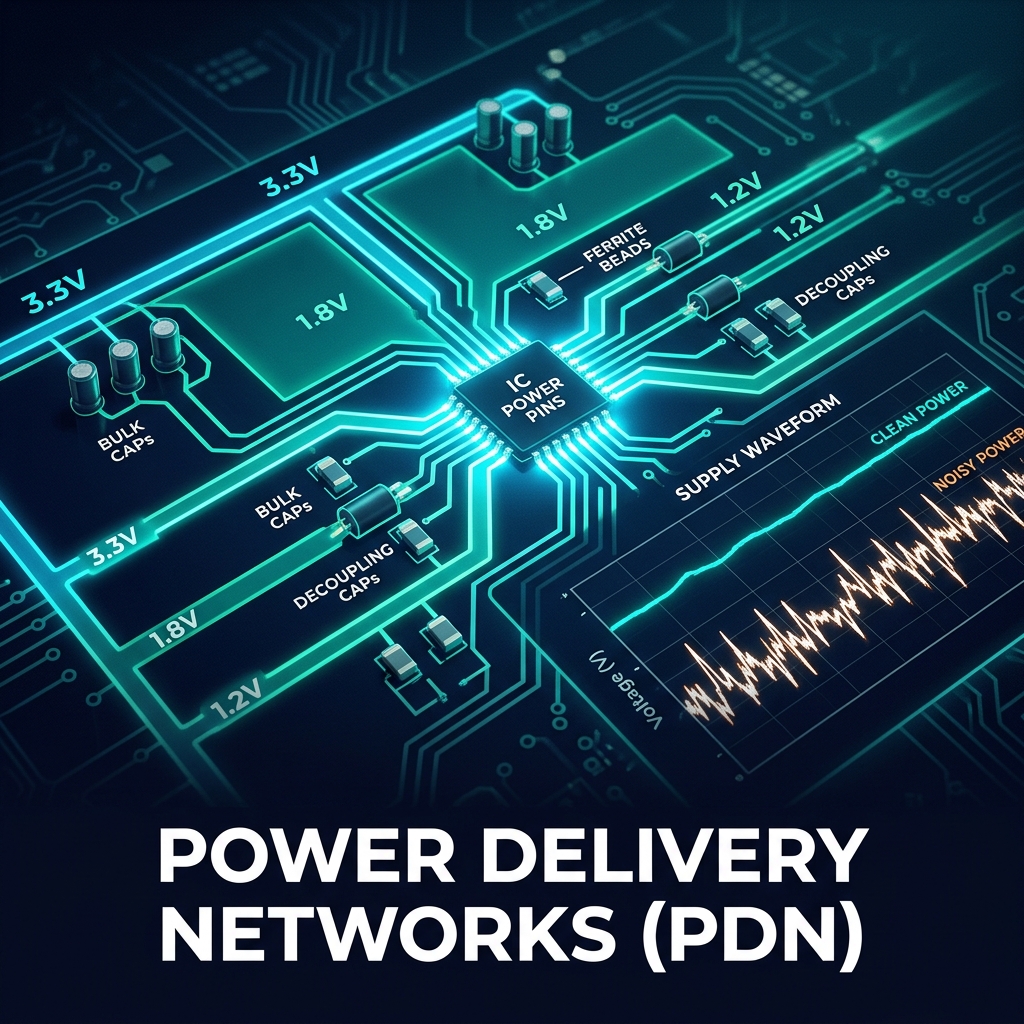
The Importance of a Good PDN
In high-speed digital designs (like microprocessors, FPGAs, and fast memory), power consumption isn't static. It happens in rapid bursts. If the power supply cannot deliver current quickly enough, the voltage drops (voltage droop), which can cause the IC to crash or corrupt data.
A Power Delivery Network (PDN) is the entire system from the voltage regulator (VRM) to the IC die, including the PCB traces, vias, and decoupling capacitors.
The Goal: Target Impedance
The primary goal of PDN design is to maintain the impedance of the power network below a specific Target Impedance across a wide range of frequencies (from DC up to hundreds of MHz or GHz).
Key Components of a PDN
- Voltage Regulator Module (VRM): Good for low frequencies (DC up to a few hundred kHz).
- Bulk Capacitors (e.g., Tantalum, Electrolytic): Provide energy for frequencies up to a few MHz.
- Decoupling Capacitors (MLCCs): Small ceramic capacitors placed as close as possible to the IC power pins. These supply instantaneous current for high-frequency transients.
- PCB Planes: Power and Ground planes placed on adjacent layers create a large, distributed capacitance with very low inductance, handling the highest frequency requirements.
Best Practices for Layout
Place decoupling caps as close to the power pins as possible to minimize trace inductance. Use multiple vias to connect capacitor pads to internal power and ground planes to reduce mounting inductance.