Neuromorphic Engineering: Building Brain-Like Circuits with Multi-Gate Transistors
The Challenge of Brain-Like Processing
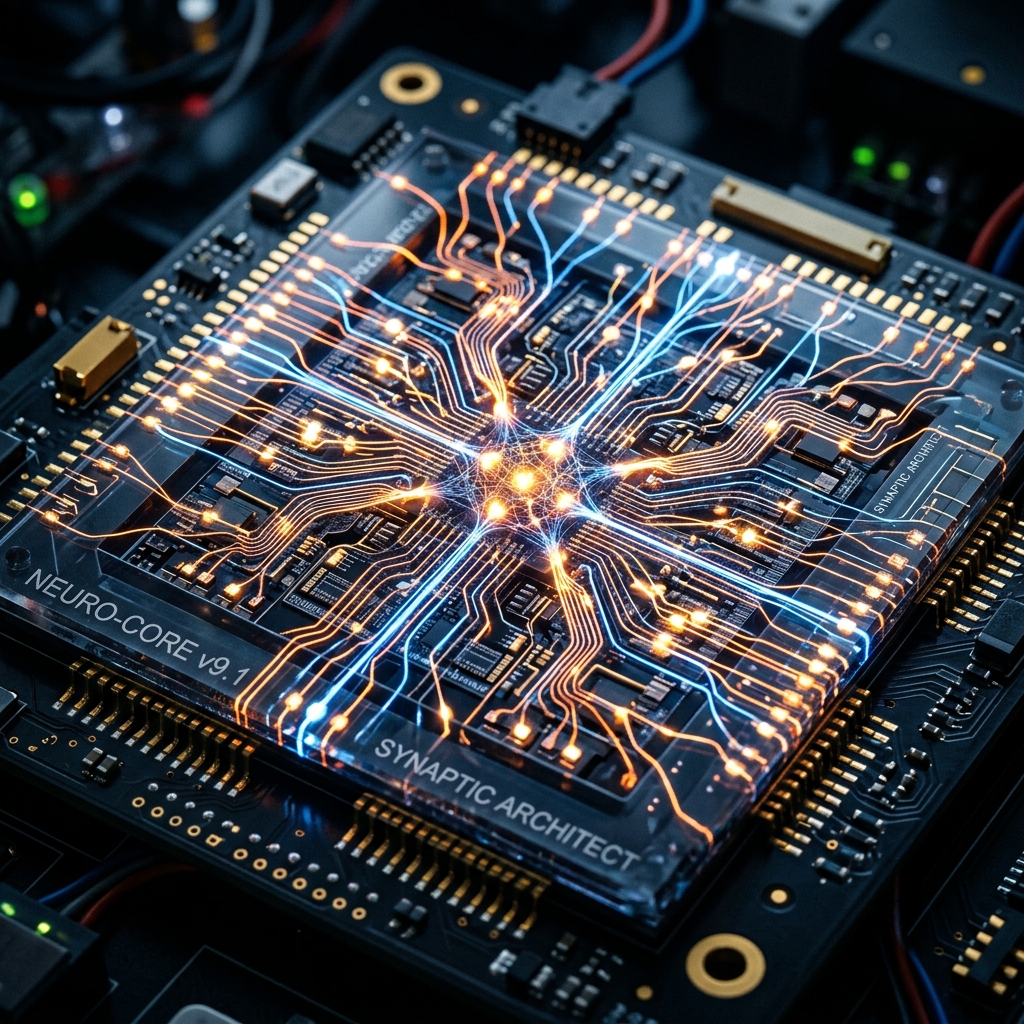
The human brain has proven to have exceptional performance in information processing while consuming very little power. It effortlessly outperforms human-made computer systems in tasks like video and voice processing or navigation. Many researchers have tried designing circuits inspired by the brain, which rely on population coding of stimuli via the synaptic plasticity that connects neurons.
IBM's True North vs. The CMOS Bottleneck
While advanced chips like IBM's True North are remarkably complex, conventional CMOS technology faces massive hurdles when attempting to scale up to the brain's level of interconnectedness. Because the fundamental CMOS transistor is a single-input device, simulating thousands of synaptic connections requires an impossibly large device count.
Multi-Gate Devices: A 9x Reduction in Device Count
To overcome this challenge, we can utilize novel multi-gate (multi-input) devices. By employing a transistor that can receive multiple input signals simultaneously, we can design highly area-efficient circuits. In recent studies, utilizing a nine-input device for the creation of basic neural circuitry demonstrated a staggering 9x reduction in total device count.
Simulating Mismatch for Random Weights
In a typical neural network, random weights are essential for encoding input signals. In neuromorphic hardware, this requirement can actually be met by leveraging the naturally occurring variations in the oxide thickness of each gate! These random variations, usually considered undesirable in standard digital design, are perfect for training analog blocks (TABs) in feed-forward neural architectures.